How to use TPU 3D printer filament for a practical purpose
TPU, or thermoplastic polyurethane, belongs to the wider family of thermoplastic elastomers. It is used when a printed object needs flexibility rather than the rigidity of ordinary PLA. A soft protective cover, a grip or a compressible spacer can involve different requirements, so define how the part should bend, stretch or recover before choosing the material.
Flexible does not mean suitable for every rubber-like application. Wall thickness, internal structure and print orientation change how an object feels. Two parts made from the same spool can behave very differently. A lattice may feel compliant while a thick solid section feels firm.
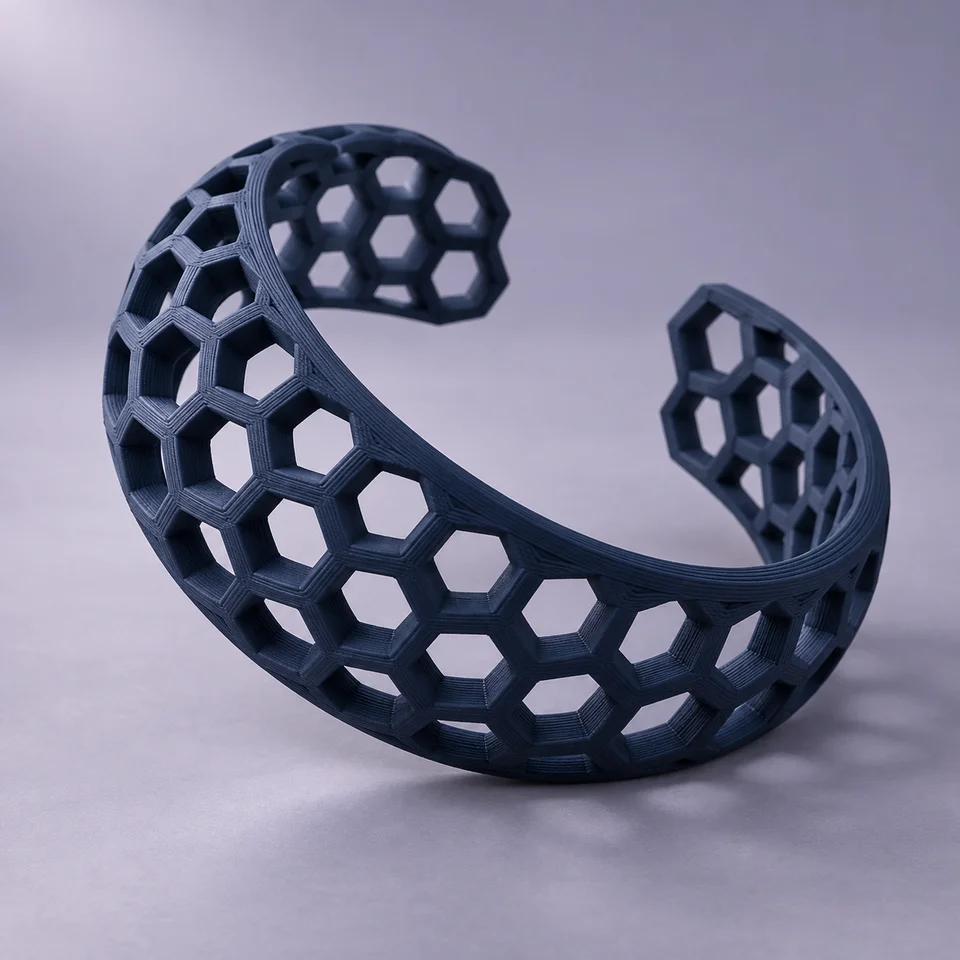
Our TPU filament catalogue is being selected. There are no verified products to purchase yet. Use this page to understand the choices and prepare your requirements. The navy lattice image is a concept illustration, not evidence of a tested product or a particular hardness rating.
Understand TPU 95A, Shore hardness and flexibility
Shore hardness describes a material's resistance to indentation on a specified scale. TPU 95A is a common label, but always check the exact product data and the scale used. Do not compare a number on Shore A directly with the same number on Shore D. A hardness label is not a complete description of elasticity, wear resistance or the behavior of a finished print.
Softer flexible filament may be harder to feed because it can bend in gaps along the extrusion path. A firmer formulation can be easier to handle, but that does not make every 95A spool compatible with every printer. Compare the manufacturer's printing instructions as well as the mechanical data.
For a flexible part, describe what you need in everyday terms before selecting a grade: a cover that can be removed, a pad that compresses under a known load, or a hinge that bends repeatedly. Then decide what dimensions and test would demonstrate that result. The product name alone cannot establish durability or fatigue life.
Check the extruder and your 3D printer feed path
Check whether the printer maker supports the exact TPU formulation and how it must be loaded. A short, well-constrained filament path can help with flexible materials. Direct drive is a useful feature to investigate, but the full feed path, extruder settings and manufacturer's guidance matter more than a single hardware label.
Automatic material systems need a separate compatibility check. For example, Bambu Lab's A1 documentation distinguishes printer support for TPU from AMS lite restrictions on flexible material. Use the documented external spool route where required. Do not assume that a printer's material list also applies to its feeder accessory.
Confirm filament diameter and spool dimensions before buying. A 1.75mm filament designation does not specify spool width or hub size. If the product is a refill, check that the reusable spool is suitable and that the winding can be loaded as instructed.
TPU printing settings, moisture and surface quality
Begin with a profile for the exact printer and filament. Printing speed, nozzle temperature, retraction and extruder tension are linked; a setting copied from a rigid PLA profile can be inappropriate. Some TPU products are marketed for higher speed, but those claims still depend on the compatible machine and profile.
Prusa notes that flexible materials are hygroscopic and can be prone to stringing. Follow the spool manufacturer's storage and drying instructions. Keep dried filament protected during a long job if the product guidance calls for it. A dry spool is one part of consistent printing, not a guarantee that every defect will disappear.
Plan support placement carefully because support removal from flexible prints can be difficult. Consider whether the part can be reoriented or redesigned to reduce difficult overhangs. Make a small representative sample before a long print, and record the settings that produced an acceptable result.
Compare TPU with PLA and PETG for your project
Choose TPU when flexibility is part of the requirement. If the object needs to stay rigid, investigate PLA or PETG instead and compare their documented properties. Do not choose a flexible filament solely because its description sounds stronger or more advanced.
Use the filament finder to organize your printer, project and preferences. We will add individual products once their specifications, prices and support details are confirmed. Until then, the material notes provide an informed starting point for comparing formulations and identifying missing information.
Choose durable, wear-resistant flexible filaments with evidence
The best 3D printing filament for a soft component depends on the design. When creating phone cases, for example, you must account for fit, openings and how the case will be removed. For a wearable prototype, a comfortable shape depends on edge geometry and surface quality as well as softness. Neither example establishes a tested use for our future products.
Creating objects that are flexible and durable involves more than selecting a popular spool. Compare flexibility and abrasion resistance separately, then investigate impact behavior, elastic recovery and layer adhesion where those properties matter. Resistance to abrasion does not establish how much force a part can withstand, or how it will behave under repeated bending.
TPU's versatility can be useful for making prototypes, but industrial applications require application-specific evidence. A designer comparing types of filaments should identify which property is missing from the current material. Avoid substituting a broad ideal-material claim for a defined requirement and a relevant test.
A Bowden feed path adds another consideration: friction and unsupported gaps can make soft filament harder to handle. Follow the printer maker's guidance rather than assuming a direct-drive recommendation is universal. Compared to other flexible formulations, one product may be easier to print on your setup while another better meets the final part's needs. Review the supported range of settings, base material and color options together.