What makes ASA filament suitable for outdoor projects?
ASA stands for acrylonitrile styrene acrylate. It is a thermoplastic considered for outdoor applications where sunlight and temperature exposure matter. Prusa describes ASA as resistant to UV light and more suitable for outdoor use than ABS. That is a useful material-family distinction, not a guarantee for every printed component or formulation.
Think about the finished object before selecting a spool: a sheltered label holder and a mechanically loaded fixture face different demands. Identify direct sun, expected temperature, water exposure and the load on the part. Then compare the exact manufacturer's data with those requirements. The durability of a finished print depends on design and processing as well as the plastic.
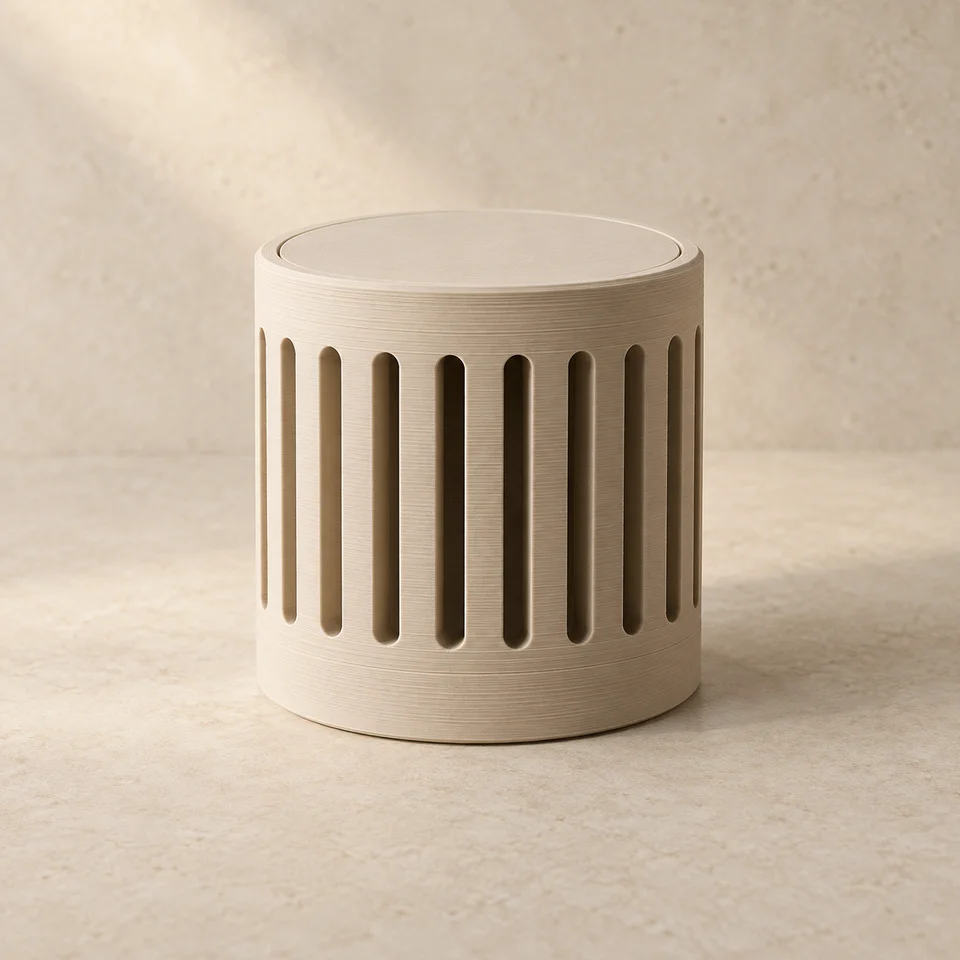
Our ASA catalogue is being prepared. There are no verified products available to order yet. These notes help you compare options while supplier, compatibility and fulfilment details are confirmed. The pictured object is an original concept illustration.
ASA vs ABS, PLA and PETG filament
ABS and ASA are often compared for functional 3D printing. ASA's weather and UV resistance can make it an attractive candidate for an outdoor part, while both demand more attention to the printing environment than everyday PLA. A familiar material name does not mean a printer is ready to use it.
PLA is often the simpler route for an indoor visual model. PETG is another family to investigate for practical parts when you want a different balance of toughness and printability. Compare documented properties rather than ranking these materials as universally better or worse. Surface finish, dimensional accuracy and layer adhesion can matter just as much as a headline strength claim.
Heat resistance figures must be interpreted in context. Look for the stated test method, load and sample preparation on the technical data sheet. Do not read a laboratory value as a safe working temperature for an arbitrary part. If the application is critical, it needs appropriate engineering assessment and testing.
Check your 3D printer and enclosure before choosing ASA
ASA can warp as it cools. Prusa recommends an enclosure for larger objects and describes the importance of a stable printing environment. Check your printer manufacturer's ASA guidance before purchase, including the supported hotend, bed and chamber conditions. A high maximum nozzle temperature alone is not proof of support.
Follow the printer and filament makers' ventilation guidance. An enclosure used to control drafts is not automatically an emissions-control system. Do not improvise a sealed enclosure around a printer whose manufacturer advises against it. Plan where the machine will run and how the specified environmental requirements will be met.
Start with the recommended slicer profile for the exact filament. Bed preparation, first-layer setup and part orientation all need attention. A small, successful sample does not establish that a much larger flat part will resist warping. Test the geometry that matters before committing to a long build.
Compare ASA products: spools, colors and nozzle requirements
Verify filament diameter before shopping. A common 1.75mm spool will not fit a system requiring a different diameter. Check net weight separately from spool dimensions: a 1kg label does not tell you the hub opening, width or feeder compatibility. Refill packaging has its own loading requirements.
Standard ASA and carbon-fiber-filled ASA are different products. Filled formulations can require a wear-resistant nozzle and a larger nozzle opening. Confirm the full material name, required hardware and product-specific profile rather than applying ordinary ASA instructions to a composite.
Choose color and finish for the intended object, but verify performance claims independently. A black spool is not evidence of a particular UV rating, and a smooth render is not proof of print quality. Keep the product's data sheet and batch information with your project notes.
When a product is described as high-performance ASA or ideal for outdoor use, ask what supports that description. Weather resistance, impact behavior and stiffness are different properties. A durable part for long-term use needs evidence relevant to its actual environment, not just an appealing category label.
ASA 3D printing uses the same basic layer-by-layer principle as other FDM 3D processes, but it places different demands on setup. An easy to print claim should explain which printer, profile and part size were used. Compare those conditions with your own equipment before expecting the same result.
Find an informed starting point for your next print
Write down your application, exposure conditions, printer configuration and desired finish. Use those details to eliminate materials your setup cannot support, then compare the remaining products when our catalogue opens. The filament finder can organize the decision, and the material library explains the broader family tradeoffs.
We will publish sourced compatibility information with individual products. Until then, an ASA category page is educational guidance, not confirmation that any particular spool works with your machine. Get launch updates if you want to know when the verified catalogue is ready.